Showing posts with label Boating and Sailing. Show all posts

Friday, April 4, 2008

Chain Stitch Lashing

Chain Stitch Lashing

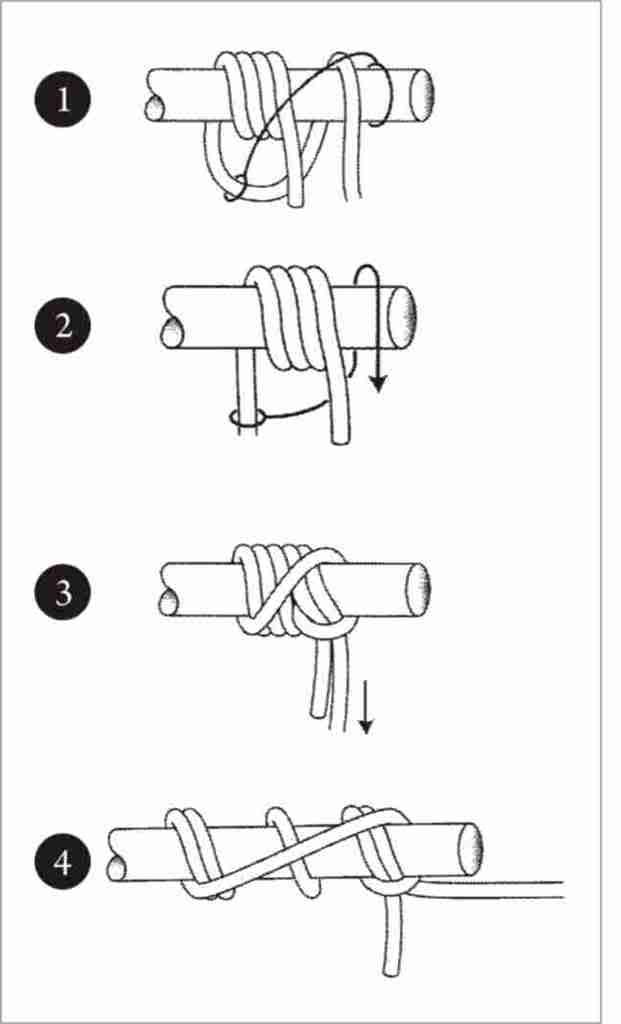
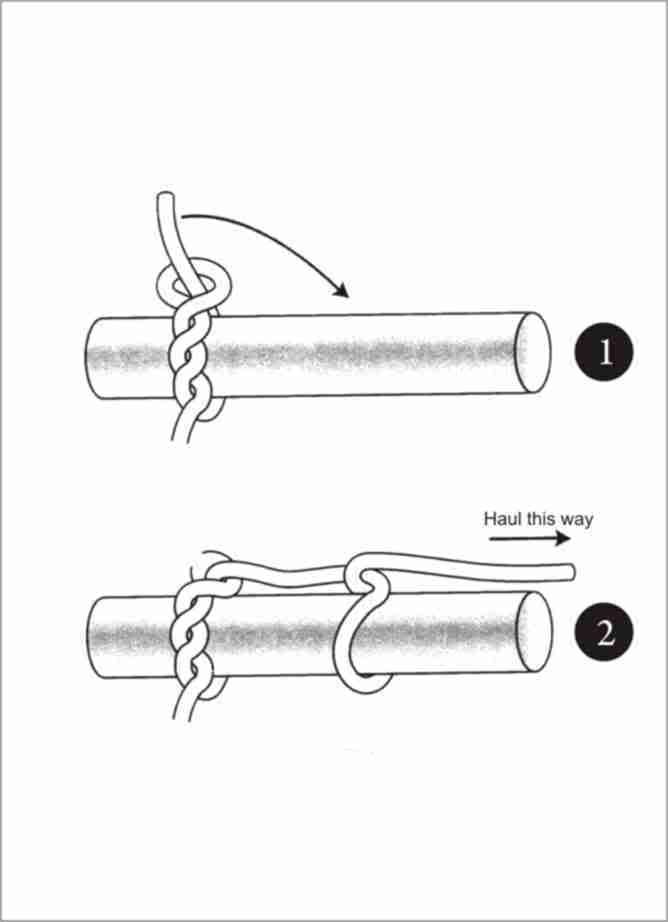
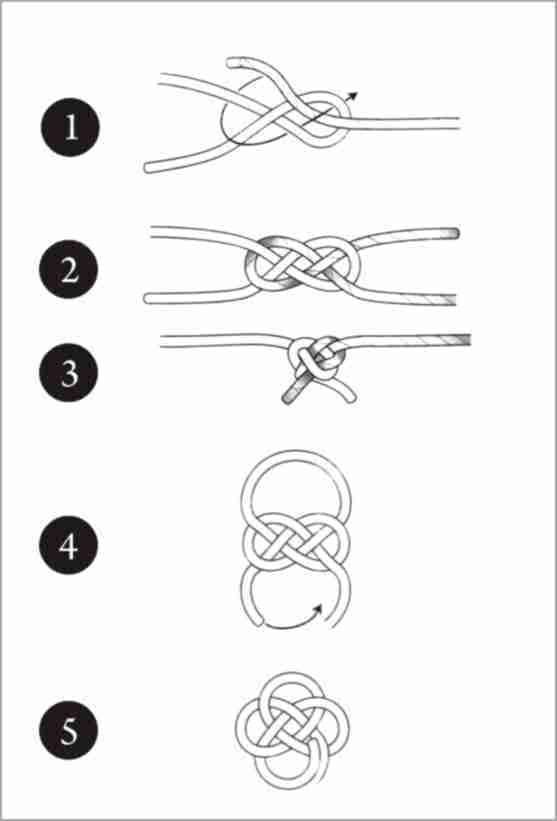
Aplications : This technique is ideal for securing a range of soft and awkward long bundles, from rolled carpets to furled sails. There is give and take in the embrace of the lashing, and it is therefore suitable for loads that bend and flex.

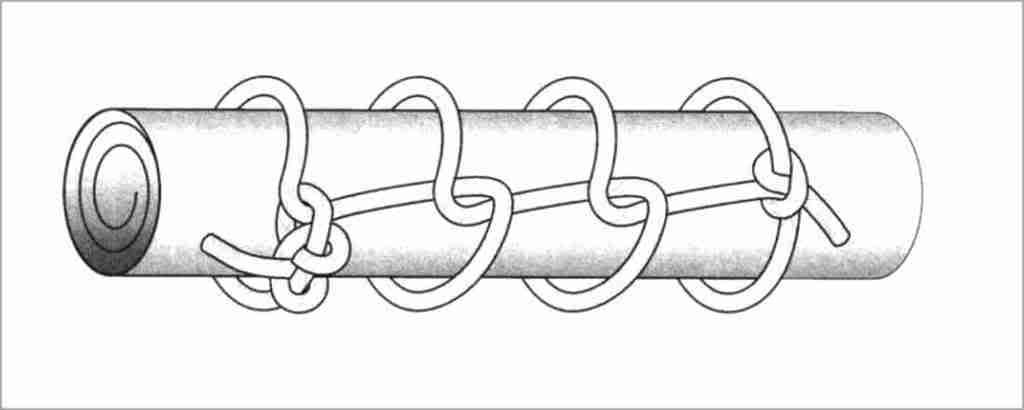
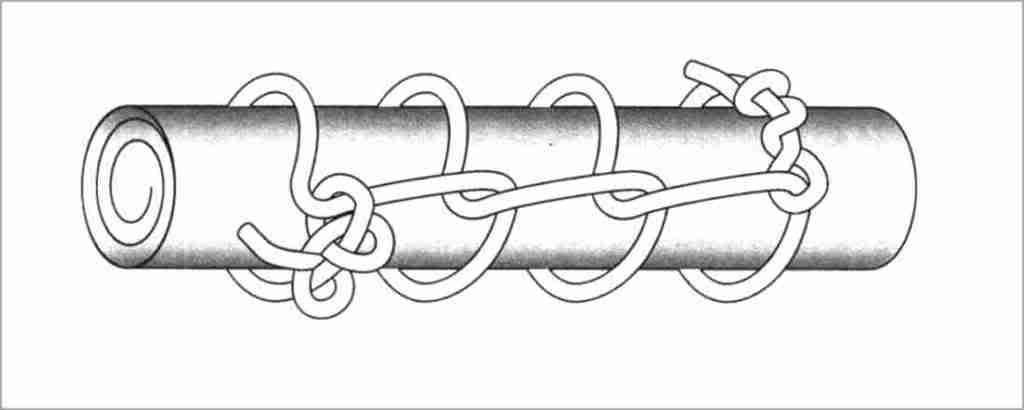
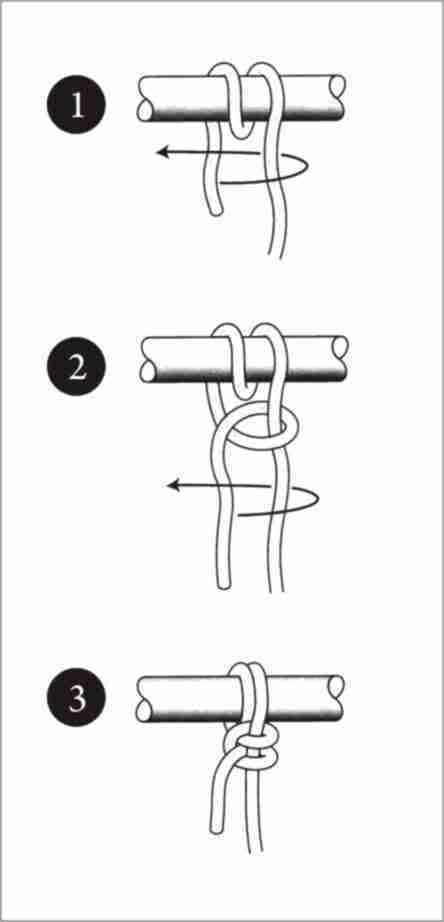
Method : This technique needs a long rope or cord. Start with a timber hitch (1 and see Killick Hitch). Loop one bight through the other, finishing off with a clove hitch (2-3, and see Clove Hitch). Untie the clove hitch, withdraw the end, pull and watch it unravel.

Marline Hitching

Marline Hitching

Aplications : Although at first glance marline hitching is identical to half-hitching ,there is a little more tying involved than in half-hitching, but this method of securing a parcel gives a better grip.

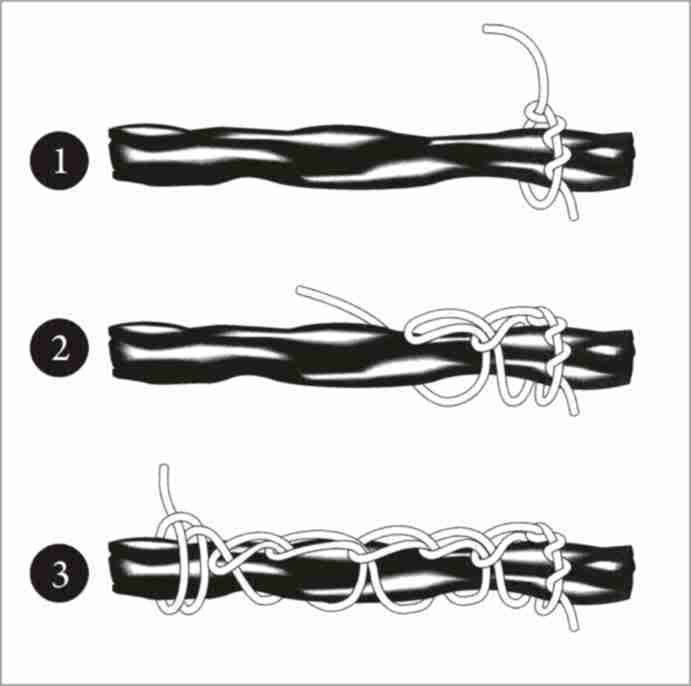
Method : Unlike half-hitching, which is a series of single hitches, marline hitching uses simple overhand knots tied along the length of the object(s) to be parcelled. Note that a working end is needed for marline hitching, although not for half-hitching. It is tricky to discern the subtle difference between these two techniques just by looking; but slide half-hitches off their bundle and they fall apart, whereas marline hitches end up as a series of overhand knots.

Half Hitching

Half Hitching

Aplications : A simple way to tie long parcels, half-hitching is closely akin to marline hitching.Many people cannot tell the difference, but there is one. Half-hitching can be done without resort to the end of the string or cord used. (See also chain stitch lashing)


Method : Using a continuous line, start with a clove, rolling or timber hitch (see Killick Hitch, Clove Hitch, Rolling Hitch). Add as many hitches at suitable intervals as necessary. Either pass the working end around and through each time, or (with an inconveniently long line) simply slide underhand loops over the end of the bale or parcel as you go.Tie off as you like.


Pole Hitch

Pole Hitch

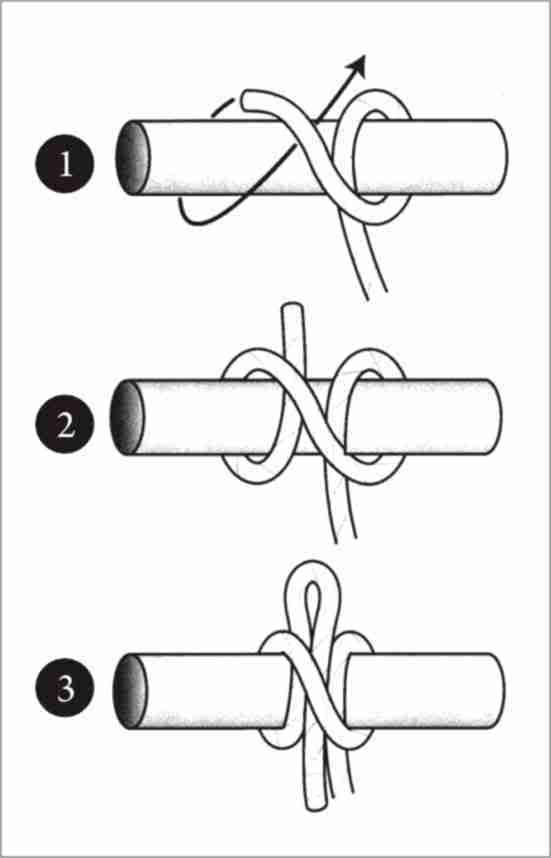
Aplications : The pole hitch is a gathering and binding knot. A pair of these will hold assorted long objects.

Method : Arrange the cord in an S- or Z-shape beneath the assembled objects, and tuck both ends through opposite bights (1). Draw tight and tie off with a reef knot (2).


History : In 1987 this hitch was recommended by the Girl Guides Association for lashing tent poles together. (See Knotting for Guides by Hazel Bailey.)

Highwayman's Hitch

Highwayman's Hitch

Aplications : A temporary tether for an animal or for mooring a boat, the highwayman's hitch may be tied in the bight of a middled rope, so that a long end is within reach to undo it again. This knot can be used to hold almost anything that will have to be released quickly or awkwardly (e.g., with one hand, or with the teeth, or from a distance).

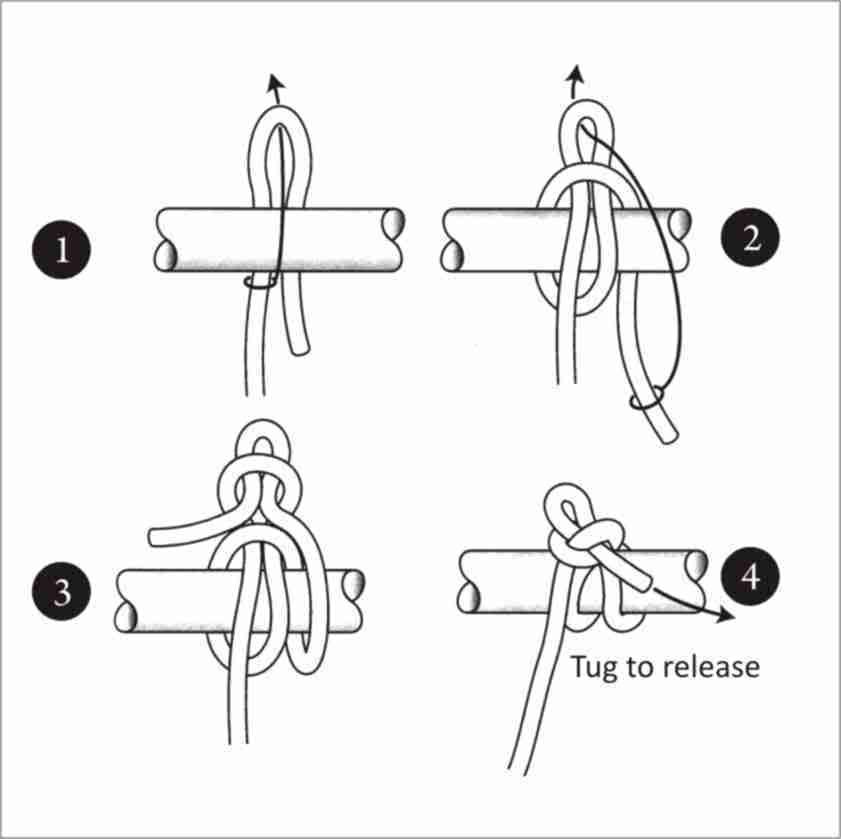
Method : This is the ultimate in draw-loop knots, tied simply by making one loop on top of another (1-4).


History : There is no evidence to substantiate the reputation of the highwayman's hitch as a quick-get-away knot for robbers on horseback.

Icicle Hitch

Icicle Hitch

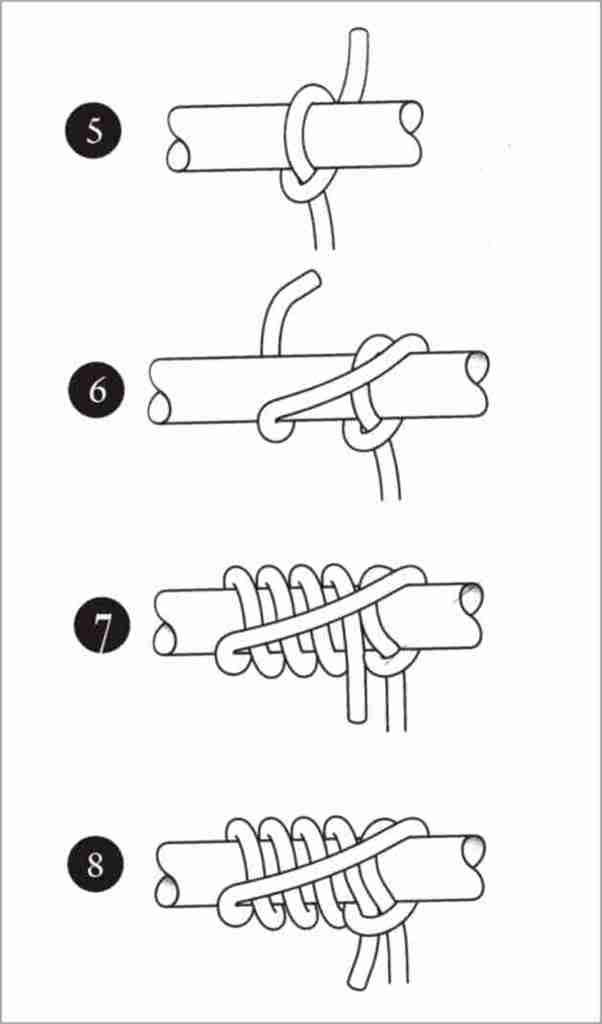
Aplications : The icicle hitch can attach a line to the smoothest of spars or rails (including a polished brass fireman's pole), even when it tapers towards the direction of pull.

Method :
A. End of spar accessible

Take at least four turns around the rail or spar (1); take more if an exceptionally secure hitch is required. With the working end, create a generous loop hanging down behind the standing part (2). Pass this loop in front of all other parts and drop it, without twisting, over the end of the spar (3). Draw everything up tight by pulling first the standing part and then the working end at right-angles to the spar. Now tighten it all again. Only then can the load be carefully applied, and the knot pulled out to the shape shown (4). There must be no separation of the two turns on the thicker part of the spar. If this occurs, add extra turns at the start. As long as two turns on the thicker part remain snug together, the hitch should hold fast.

B. End of spar inaccessible
Using the working end, assemble the knot as shown (5-8), but then tighten it until it behaves as already detailed in A above.

History : An ex-tended pile hitch (see p. 72), the icicle hitch was devised by John Smith of Surrey, England. He demonstrated his knot's quite exceptional grip in May 1990 at the eighth Annual General Meeting of the International Guild of Knot Tyers, held at the training ship Steadfast, a Sea Cadet shore establishment at Farnham in Hampshire. Smith hung by this hitch from a splicing fid, which was suspended, point down, from the ceiling.


Scaffold Knot

Scaffold Knot

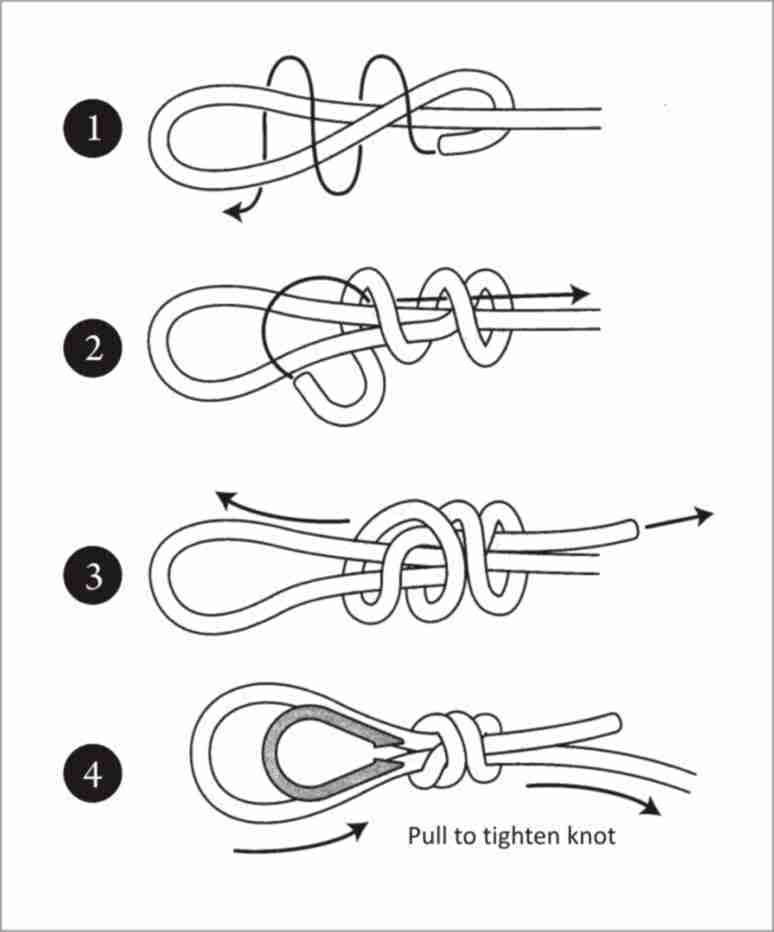
Aplications : This is a tough noose knot, which may be protected against wear due to chafing by the insertion of a plastic or metal lining called a thimble, creating what sailors refer to as a 'hard eye: Thimbles come in a range of sizes and are obtainable from boat and yacht chandlers. Practised fingers can tie the scaffold knot in 30 seconds or less.


Method : First make the loop and tighten the sliding knot (1-3). Next, insert the thimble (4). See that its jaws bed down into the throat of the noose and pull the whole lot snug. To attach a line directly to a ring or bracket, without using a shackle, fix the thimble in place and pass the working end of the line around it before tying the knot.


History : The scaffold knot was described in Denis Diderot's Encyclopedie of 1762.

Tuesday, April 1, 2008

Heaving Line Knot

Heaving Line Knot

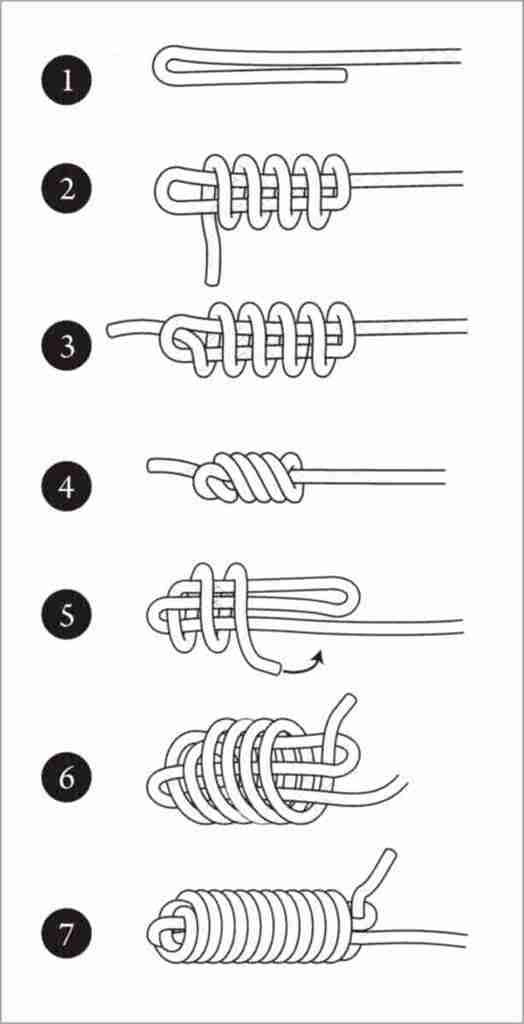
Applications : Throwing lines fly better through the air if the end is weighted, and this is one knot for the job. (See also monkey's fist) Tied in a length of cord it makes a neat, convenient hank to carry in a rucksack or on a belt loop.

Method : Make a bight and wrap the two adjacent parts with the working end (1-2). After tucking the working end, pull all slack through the knot (first one way, then the other) until it emerges where the standing part enters the knot (3-4). For a bulkier version of the same knot, wrap three standing parts (5-7).


History : The heaving line knot and variations on it have been recorded since at least the nineteenth century.

Saturday, March 29, 2008

Lighterman's hitch

Lighterman's hitch

Applications : When tied around a towing post or hook, this is a superb hitch for securing one boat, barge or ship to another. It also serves to belay a heavy-duty ship's mooring or a marquee guy-line. Whatever the use, it will hold fast, but it cannot jam and is quickly cast off.

Method : Take a turn (or two or three) to apply whatever friction the job demands (1).Once the strain is taken up and the line length adjusted for the job in hand, take a bight beneath the standing part and hitch it over the post, bollard or stake (2-3). Wrap the end around once and let it hang (4).

Anchor Bend

Anchor Bend

Applications : Used on small boats for securing rope warps to anchor rings, this knot is misleadingly named. It is actually a strong-ish (70-75%) and secure hitch for wet and slimy conditions.

Method : Take a round turn but then pass the first of two identical half-hitches through it (1-3).The 1904 variant (4) is a round turn through a round turn, which, when it has been systematically worked up snug, makes a semi‑ permanent knot.


History : The anchor bend was recommended by David Steel in Elements and Practice of Rigging and Seamanship (1794). It is also known as the fisherman's bend. A neat variant appeared in the anonymous Handbook of Boat Sailing (1904).

Round turn and two half-hitches

Round turn and two half-hitches

Applications : This is a classic old hitch for securing a line to a ring, rail or to a spar.

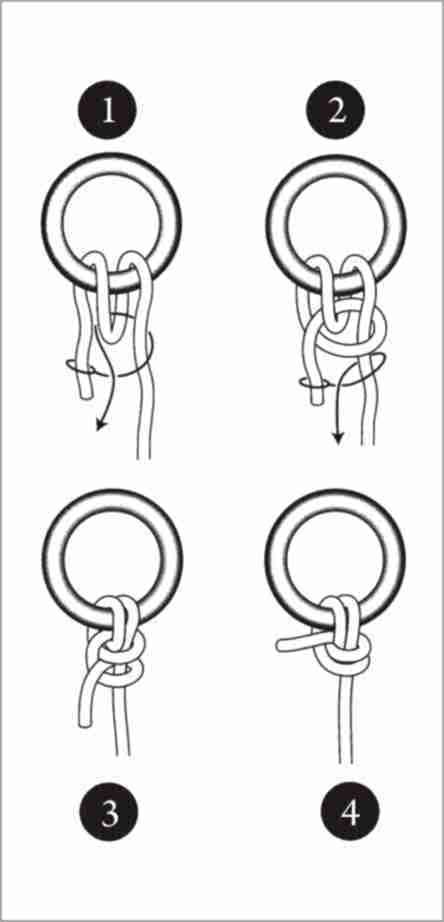
Method : Use the friction of the round turn (1) to snub and hold the load; then add the two identical half-hitches (2-3).The two half-hitches have a breaking strength of 60-75%, but the round turn may increase that percentage.


History : In 1794 David Steel referred to this hitch (by the same name) in Elements and Practice of Rigging and Seamanship.

Buntline Hitch

Buntline Hitch

Applications : The buntline hitch was traditionally used to secure a lanyard to a cringle, eyelet, ring or swivel. These days it is also used on tools with small holes in their handles. Note the short end trapped on the inside of the knot (3).This is not recommended in cases where the hitch needs to be undone easily, because it is likely to jam and resist the efforts of fingers to free it. However, where something more secure than the normal two half-hitches is needed, the buntline hitch is useful. When tied in a strip of material, it turns out to be the common knot used for men's neckties (one of life's lesser-known trivial facts).

Method : Make two half-hitches, tying the second inside the first (1-3).


History : The buntline was attached to a sail's footrope, then passed up in front of that sail to a block on the yard, from where it could be used to pull the bottom of the sail up and so spill the wind out of it. As the sail was going to flap about a lot, a very secure knot was needed.

Snuggle Hitch

Snuggle Hitch

Applications : Useful for attaching a line to a spar or rope, the snuggle hitch is stronger than either the clove or rolling hitches . It may be used with a right-angled or a lengthwise pull.

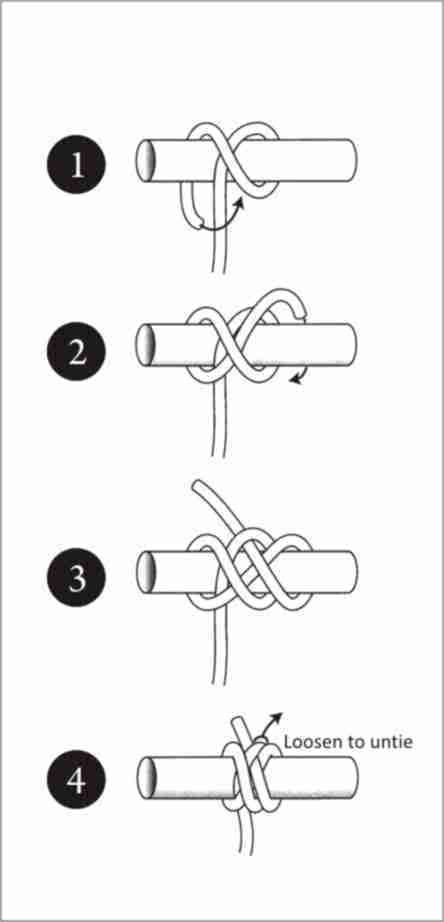
Method : For a lengthwise pull, ensure that the two adjacent wrapping turns are on the same side of the standing part as the load (1-3). Once the load is released, the knot may be untied by either pulling or prising loose the part arrowed (4).The working end can then be withdrawn.


History : The snuggle hitch was devised by Owen K. Nuttall of West Yorkshire, England, and was first published in Knotting Matters in January 1987.

Rolling Hitch

Rolling Hitch

Applications: A close relation of the clove hitch, the rolling hitch attaches a cord to a rope for a lengthwise pull. For smooth rails or spars, consider using the icicle hitch .

Method : Begin as for the clove hitch (1) but take two adjacent diagonal turns on the side of the knot from which the pull will come (2-3). Take care to lock the second diagonal turn inside the first one, i.e., alongside the standing part of the line.


History : This knot was known in earlier days as Magner's hitch or the Magnus hitch.

Clove Hitch

Clove Hitch

Applications : This simple but versatile knot will moor a small boat, suspend a fender or attach any line to a post, rail or ring when the pull is a steady one at right-angles to the point of attachment. However, simplicity has its shortcomings. If pulled around, the clove hitch can work loose. Perversely, it can also jam when wet. Its breaking strength is variously quoted as between

Method : This knot can be tied by tracing a letter N (or its mirror image) with the working end (1-2). For a temporary task, such as hanging a fender, leave a draw-loop (3). Stepping ashore from a slow-moving boat, first cast an underhand loop onto a bollard and use the friction to check the momentum; then, once the line is the length you want it, simply drop the second loop onto the first. Add a half-hitch for extra security.To ensure the direction of pull on a mooring painter does not vary, bring it ashore around a stanchion or other convenient fixed point before attaching it to a post or rail.


History : An old treatise referred to this knot as a builder's knot. William Falconer may have been the first to name it the clove hitch in his Universal Dictionary of the Marine (1769). Aboard ship it was used to secure ratlines to shrouds, creating those rope ladders up which sailormen scrambled to man the yardarms.

Killick Hitch

Killick Hitch

Applications : Use the killick hitch to tow long loads through water or drag them overland. It works well on rough objects, such as tree trunks, but can slip on smooth spars.

Method : Begin by making a timber hitch (fig.1).Three tucks or turns were enough to do this using vegetable-fibre rope but more may be prudent when using today's smoother braids. In hawser-laid rope it is traditional to dog the turns the same way as the lay. Arrange the direction of pull to preserve the twist of the timber hitch. I personally always make the half-hitch so that the end emerges the same way as it does from the initial knot (2). Note that the half-hitch, with its elbows, almost certainly reduces the breaking strength (70%) of the initial timber hitch.


History: The killick is essentially a timber hitch with an additional half‑ hitch to give direction to the line of pull. The timber hitch is an old knot, mentioned in A Treatise on Rigging (c. 1625) and illustrated by Denis Diderot in his Encyclopedie of 1762. It has been used since time immemorial. The killick hitch was illustrated and named by David Steel in Elements and Practice of Rigging and Seamanship (1794), a killick being a naval term for a small anchor (or even a rock used as one). Thus the killick hitch used to be an anchor knot for a boat, buoy or lobster pot.

Mooring

Mooring

Applications : This is a versatile slide-and-grip knot, with the extra facility of a quick-release draw-loop. It will moor a dinghy, tether a docile animal and act as the DIY enthusiast's occasional'third hand'.

Method: Tying the mooring hitch is simplicity itself (1-2), with the draw-loop making an over-under-over locking tuck.


History: The history of the mooring hitch is anybody's guess. Mine is that it could have been a medieval archer's adjustable bowstring knot.

Friday, March 28, 2008

Knute Hitch

Knute Hitch

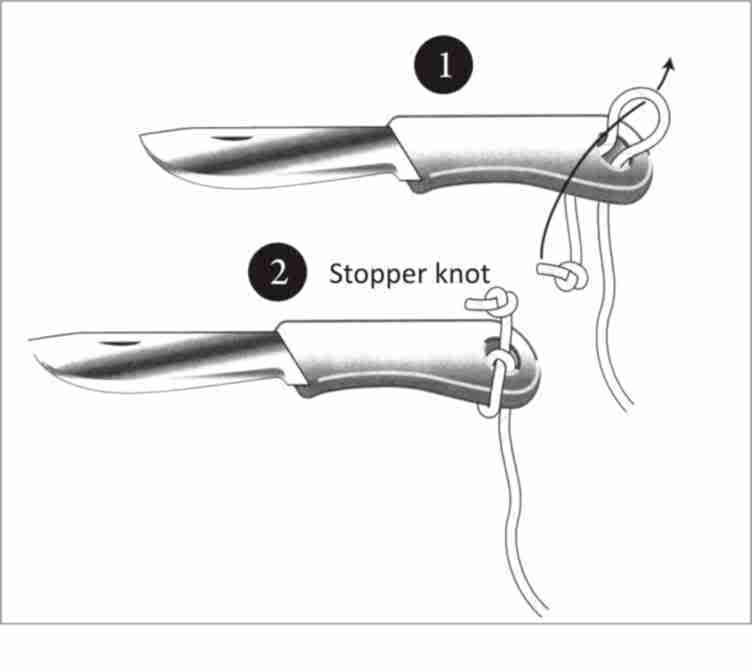
App;ications : Use the Knute hitch to attach a line to anything with a hole not much larger (for obvious reasons) than twice the diameter of the cordage used. This hitch is often tied to fix lanyards to knives and other tools. Europe's largest sailing school, in Poole Harbour, England, uses it to attach the main halyards to the mainsails on its Wayfarer dinghies, no doubt saving on the cost of shackles lost overboard from wet, cold and inexperienced fingers.

Method : Thread a bight and trap the working end with it (1), finishing off either with a stopper knot or with one of those big plastic beads sold in yacht chandlers (2).


History : US master ringger, writer and broadcaster Brion Toss named this hitch in 1990 but it is probably centuries old

Zeppelin bend

Zeppelin bend

Applications : This is probably the best of a whole trustworthy family of symmetrical bends comprising two interlocked overhand knots. It works even in big stiff hawsers and cables and is suitable for everything from hobbies to heavy industrial use.

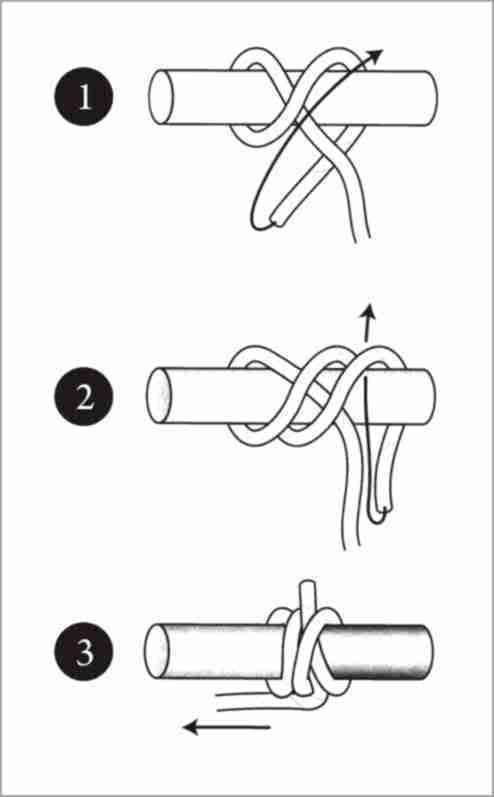
Method : Rosendahl's tying method is a trifle awkward and so an easier way (1-3) has been devised by Ettrick W. Thomson of Suffolk, England. The knot does not have to be completely tightened before loading; it is secure even with daylight showing through it (4).To untie the knot, push and pull on the twin encircling bights -tap them with a mallet if necessary - until some slack is obtained. Then, bit by bit, loosen the whole arrangement. It is possible to untie Zeppelin bends that have borne loads of several hundred tonnes.


Carrick bend

Carrick bend

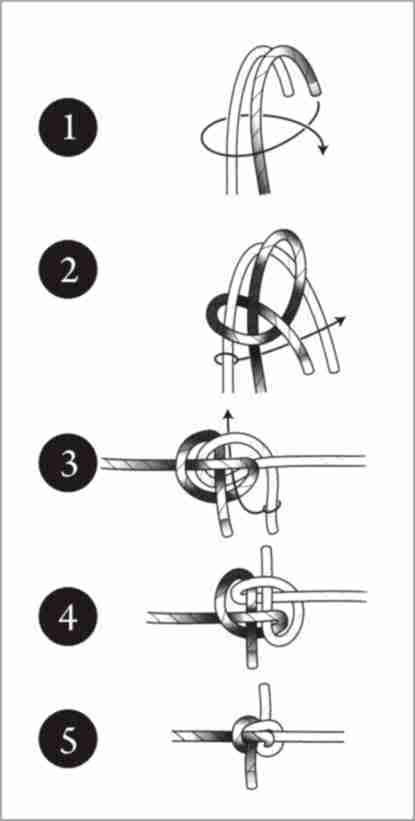
Applications : This is a bend for joining larger ropes and cables. Although often assumed to be strong, it is in fact only about 65% efficient.

Method : Weave the ropes over and under (1-2). Arrange the layout so that the working ends emerge on opposite sides of the knot. Pull the knot tight, capsizing it into its stable working form(3).The version with both short ends on the same side (4) may be less secure and so is not recommended as a bend. (However, it is a crucial knot for students of mathematical knot theory) Bring the working end around to re-enter the knot (5), doubling and trebling the lead, to make a decorative Turk's head mat or bracelet.


History : The symmetrical layout of the carrick bend, with eight crossing points, yields several different knots, depending on what goes over and under where. For this reason , some very unreliable knots have been misleadingly labelled carrick bends. the true carrick bend was named by M. Lescallier in Vocabulaire des Termes de marine (1783) and featured by Felix Reisenberg in Seamanship for the Merchant Service (1922). The name 'carrick' may come from medieval trading ships called carracks.

Template by - Abdul Munir | Daya Earth Blogger Template