Showing posts with label Angling and Fishing. Show all posts

Saturday, March 29, 2008

Buntline Hitch

Buntline Hitch

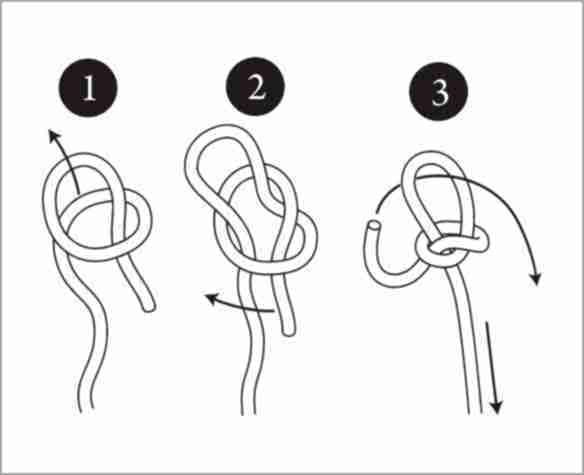
Applications : The buntline hitch was traditionally used to secure a lanyard to a cringle, eyelet, ring or swivel. These days it is also used on tools with small holes in their handles. Note the short end trapped on the inside of the knot (3).This is not recommended in cases where the hitch needs to be undone easily, because it is likely to jam and resist the efforts of fingers to free it. However, where something more secure than the normal two half-hitches is needed, the buntline hitch is useful. When tied in a strip of material, it turns out to be the common knot used for men's neckties (one of life's lesser-known trivial facts).

Method : Make two half-hitches, tying the second inside the first (1-3).


History : The buntline was attached to a sail's footrope, then passed up in front of that sail to a block on the yard, from where it could be used to pull the bottom of the sail up and so spill the wind out of it. As the sail was going to flap about a lot, a very secure knot was needed.

Clove Hitch

Clove Hitch

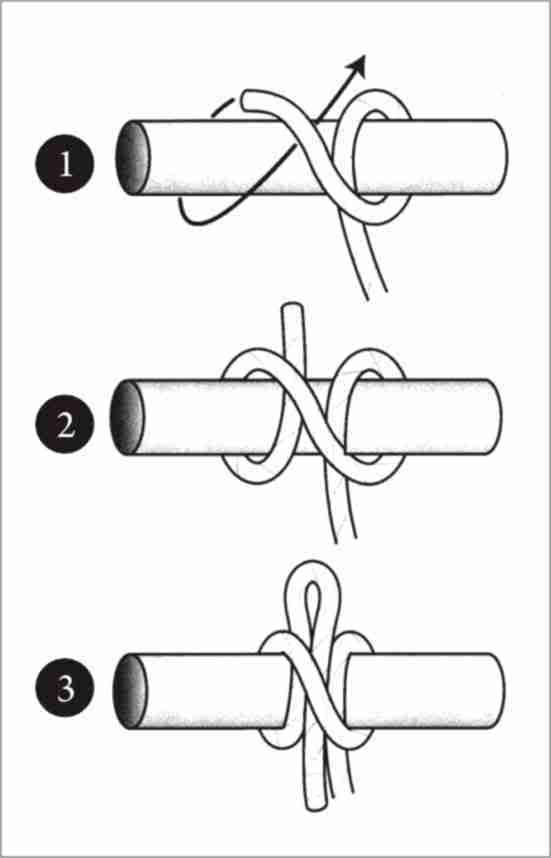
Applications : This simple but versatile knot will moor a small boat, suspend a fender or attach any line to a post, rail or ring when the pull is a steady one at right-angles to the point of attachment. However, simplicity has its shortcomings. If pulled around, the clove hitch can work loose. Perversely, it can also jam when wet. Its breaking strength is variously quoted as between

Method : This knot can be tied by tracing a letter N (or its mirror image) with the working end (1-2). For a temporary task, such as hanging a fender, leave a draw-loop (3). Stepping ashore from a slow-moving boat, first cast an underhand loop onto a bollard and use the friction to check the momentum; then, once the line is the length you want it, simply drop the second loop onto the first. Add a half-hitch for extra security.To ensure the direction of pull on a mooring painter does not vary, bring it ashore around a stanchion or other convenient fixed point before attaching it to a post or rail.


History : An old treatise referred to this knot as a builder's knot. William Falconer may have been the first to name it the clove hitch in his Universal Dictionary of the Marine (1769). Aboard ship it was used to secure ratlines to shrouds, creating those rope ladders up which sailormen scrambled to man the yardarms.

Friday, March 28, 2008

Knute Hitch

Knute Hitch

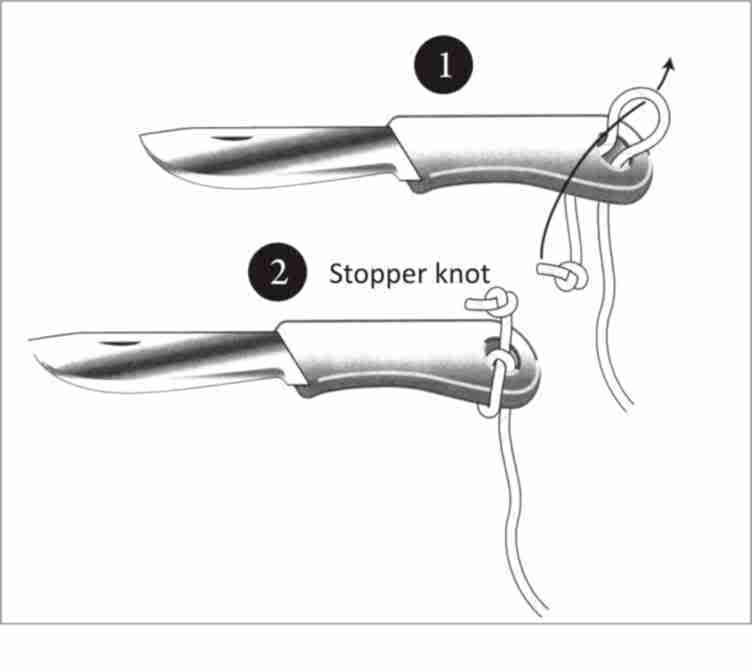
App;ications : Use the Knute hitch to attach a line to anything with a hole not much larger (for obvious reasons) than twice the diameter of the cordage used. This hitch is often tied to fix lanyards to knives and other tools. Europe's largest sailing school, in Poole Harbour, England, uses it to attach the main halyards to the mainsails on its Wayfarer dinghies, no doubt saving on the cost of shackles lost overboard from wet, cold and inexperienced fingers.

Method : Thread a bight and trap the working end with it (1), finishing off either with a stopper knot or with one of those big plastic beads sold in yacht chandlers (2).


History : US master ringger, writer and broadcaster Brion Toss named this hitch in 1990 but it is probably centuries old

Carrick bend

Carrick bend

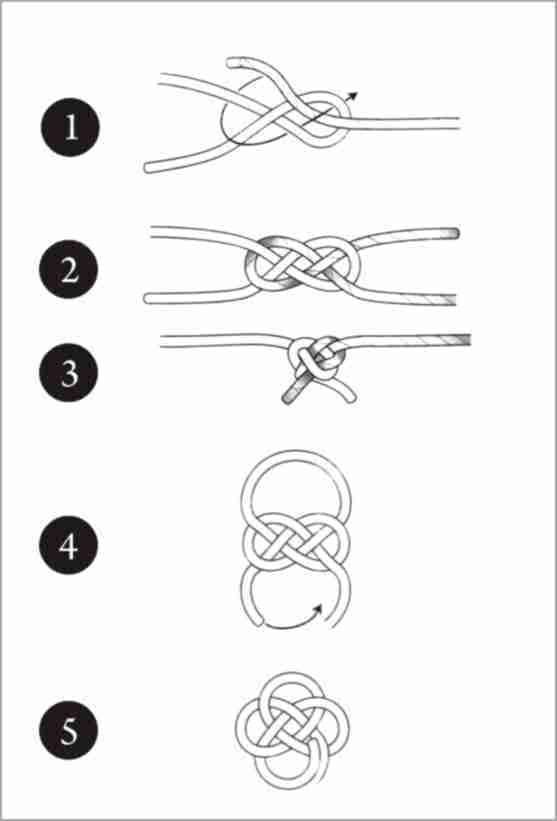
Applications : This is a bend for joining larger ropes and cables. Although often assumed to be strong, it is in fact only about 65% efficient.

Method : Weave the ropes over and under (1-2). Arrange the layout so that the working ends emerge on opposite sides of the knot. Pull the knot tight, capsizing it into its stable working form(3).The version with both short ends on the same side (4) may be less secure and so is not recommended as a bend. (However, it is a crucial knot for students of mathematical knot theory) Bring the working end around to re-enter the knot (5), doubling and trebling the lead, to make a decorative Turk's head mat or bracelet.


History : The symmetrical layout of the carrick bend, with eight crossing points, yields several different knots, depending on what goes over and under where. For this reason , some very unreliable knots have been misleadingly labelled carrick bends. the true carrick bend was named by M. Lescallier in Vocabulaire des Termes de marine (1783) and featured by Felix Reisenberg in Seamanship for the Merchant Service (1922). The name 'carrick' may come from medieval trading ships called carracks.

Bowline In The bight

Bowline In The bight

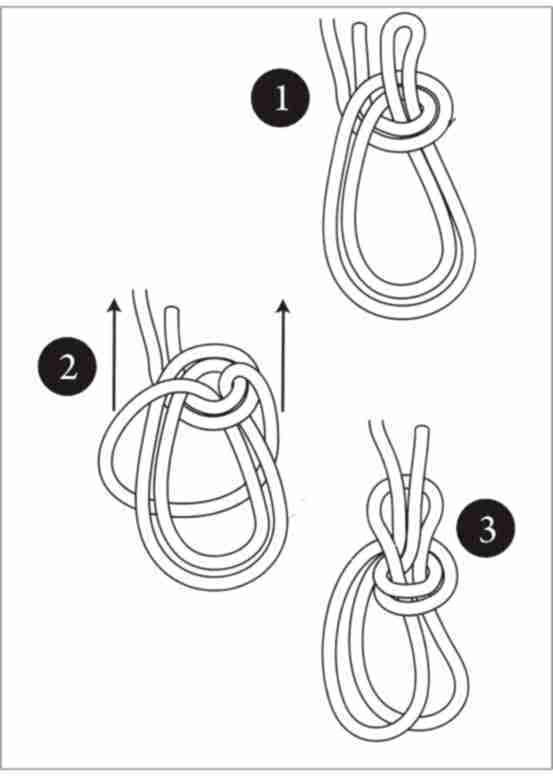
Applications : In these litigious, health-and ­safety conscious times, I do not recommend any ad hoc rope slings and chairs for working aloft or over the side. There are tested and certificated ladders and stages and harnesses for the well prepared. But all sailors sooner or later are faced with some urgent improvisation. This is one such knot, which can be used for lowering an injured person and other emergencies. One leg is put through each loop and the patient (if conscious and capable) holds tight onto the rope at chest level, or is somehow secured to it. It reduces the strength of the line in which it is tied by up to 40%.

Method : As this knot is usually tied in the middle of a rope, it must be made without using either end. The early stages are done with a doubled end (1).The trick is then to pass the bight right over the pre­formed knot (2-3).


History : This knot was illustrated in 1795 by Johann R. in his Allgemeines Worterbuch der Marine. In 1808 it was mentioned as the 'bowline upon the bight' by Darcy Lever, Author of Sheet Anchor.

Bowline

Bowline

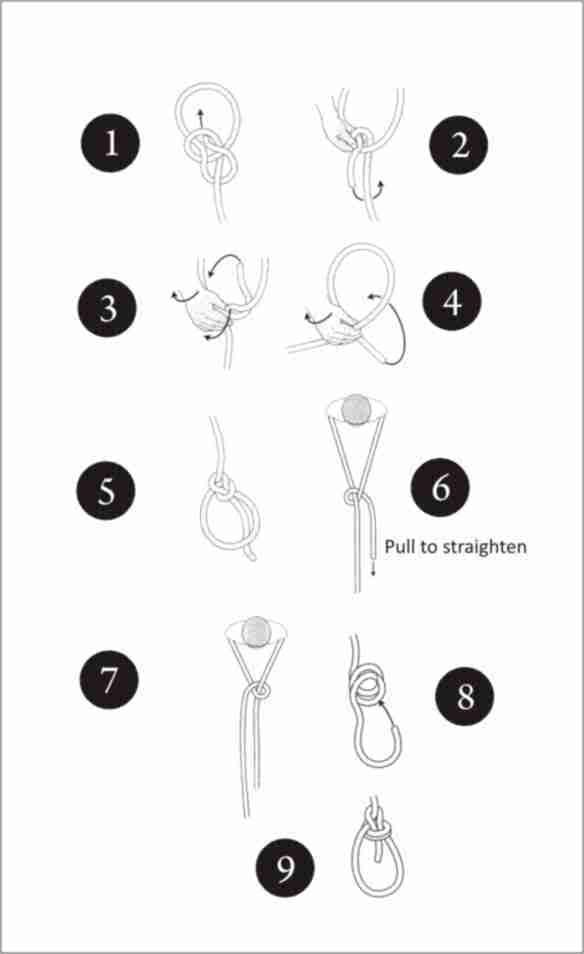
Applications : Neither a bend nor a hitch, the bowline (say 'boh-linn') is a knot that makes a fixed loop. It is far from the strongest loop knot, reducing the breaking strength of any stuff in which it is tied by as much as 40%. Nor is it very secure, particularly when the rope is stiff or slippery, when it has been known to capsize (if excessively loaded) or alternatively to spring or shake itself apart (when unloaded).Nevertheless the bowline can be used for a wide range of jobs, from securing the string before tying a parcel, to outdoor pursuits such as climbing. When I was a Metropolitan Police frogman in the 1960s, my colleagues and I tied the line around our waists with a simple bowline. The working end (deliberately made long) was then tucked several times around the adjacent part of the loop to secure it. Climbers' manuals advise their readers to finish off such tucks with one or two half-hitches (made in the opposite direction to the twist) for even greater

Methods : Make it by the so-called sailor's method with a fluent, one-handed twist of the wrist (1-5).You should also work out how to tie a bowline viewed from an unfamiliar angle (6-7). Imagine facing someone, passing a rope around behind them, beneath their armpits, then having to make the knot. See what I mean? The trick is to first take a turn around the standing part of the rope with your working end. Next, pull it out straight to transfer the underhand loop in the standing part. Finally, pass and tuck the working end to lock off in the usual way.If the knot will have to withstand rough treatment, tie the double bowline (8-9). This is therefore stronger and far more secure than a basic bowline


History : Stone Age en knew the sheet bend, which has an identical layout to the bowline, the only difference being which end is used where and for what. There is, however , no evidence of the bowline having been used that far back in the time. It was mentioned as a seafarer's knot by Sir Henry Mainwaring in The Sea-man's Dictionary (1644) and first illustrated in David Steel's Elemants and practice of Ringging and Seamanship in 1794. The time is long gone when it really was a 'bow line knot', used to hold the weather leech of a square sail forward closer to the wind, preventing it being pulled back. Other nautical uses include looping a boat's painter or ship's mooring rope around a quayside bollard, and tying a line around a crewman's waist, to lower him over the side. Two interlocked bowlines also form a handy hawser bend. Some useful variants on the common bowline (e.g., a double bowline, a bowline in the bight and a couple of triple bowlines ). All however, rely upon you first mastering the basic knot.

Thursday, March 27, 2008

Ashley's Stopper Knot

Applications : use this chunky hole blocker when the figure eight knot too small.

Method: Tie a simple noose (1-2). tuck the working end as shown (no other way will do), pulling the noose tight to trap it (3). a characteristic of completed knot is a neat trefoil of three overlapping parts on its underside.


History : Clifford W. Ashley, whose monumental work The Ashley Boo of Knots is every knot enthusiasts bible, devised this knot sometime before 1910. He was trying to imitate a lumpy knot he had seen from a distance on the foresail halyard of a passing boat in an oyster fishing fleet (hence his name for it, an oysterman's stopper). later, when he went aboard for a closer look, the knot in question turned out to be merely a wet and swollen figure eight knot. So good is Ashley's own knot, however, that there have recently been moves to honour him by featuring it on an American postage stamp.

Template by - Abdul Munir | Daya Earth Blogger Template